Lead vs. Prospect vs. Opportunity: What’s the Difference and Why Does It Matter?

-

Quick answer: What is the difference between a lead, a prospect, and an opportunity?
A lead is an unqualified contact who’s shown some initial interest in your company but hasn’t been vetted yet. Once you’ve confirmed that a lead fits your ideal customer profile based on factors like budget, authority, and need, they become a prospect. An opportunity is a prospect who’s expressed a genuine interest in buying and is actively engaged in your sales process, making them one of the most valuable contacts in your pipeline.
Key takeaways
- Leads are unqualified: A lead is anyone who could realistically buy from you — but most won’t fit your ideal customer profile until you vet them.
- Prospects are qualified leads: Once a lead meets your criteria for budget, authority, need, and timeline, they become a prospect worth pursuing.
- Opportunities are ready to buy: An opportunity is a prospect who’s expressed genuine interest — they’re one conversation away from becoming a customer.
- The stakes are real: Well-qualified deals are 6.3 times more likely to close and close 21.6% faster, according to Ebsta’s analysis of more than 655,000 B2B opportunities.
- Your CRM should do the heavy lifting: Tracking leads, prospects, and opportunities in a single system keeps your team focused on the right conversations at the right time.
Lead vs prospect vs opportunity: Why it’s confusing
The lead vs. prospect vs. opportunity debate confuses many sales teams, but understanding the difference is critical for pipeline management.
If you’re not sure when to use the terms prospect, lead, or opportunity, you’re not alone. Some people think these terms refer to the same thing. Others believe they refer to different things but that the differences don’t matter. Then there’s the fact that certain sales apps actually use terms like lead, prospect, and sales opportunity to describe specific metrics.
In this article, we’ll give you the definitions of these three terms so that you know the differences between them. Then we’ll explain why these differences are important to understand and dive into lead generation vs. prospecting. Finally, we’ll show you how to effectively move leads through your sales pipeline.
Table of Contents
- What leads, Prospects and Opportunities actually mean
- What are leads?
- What are prospects?
- What are sales opportunities?
- Why sales and marketing need to agree on these definitions?
- Why does any of this matter?
- Lead qualification benchmarks
- Your sales funnel
- How are leads generated?
- How to convert leads to prospects
- How to move leads through your pipeline
- How to convert prospects to opportunities
- Common pitfalls in the lead to opportunity process
- Lead vs. prospect vs. opportunity FAQs
What leads, prospects, and opportunities actually mean
Before we dive into the details, here are the core definitions you need to know:
Lead: An unqualified contact who has shown some initial interest in your company but hasn’t been vetted. They might have visited your website, filled out a form, or attended a webinar. You know their name and maybe their company, but you don’t yet know if they’re a good fit for what you sell.
Prospect: A qualified lead who has been researched and confirmed to match your ideal customer profile. You’ve verified they have the right company size, budget potential, decision-making authority, or other criteria that make them worth your sales team’s time. The key difference: prospects are leads that have passed through your qualification process.
Opportunity: A qualified prospect who has expressed genuine interest in making a purchase and is actively engaged in your sales process. They’ve moved beyond just “might buy someday” to “wants to evaluate our solution now.” These are the deals in your pipeline with a realistic chance of closing.
Think of it this way: leads are everyone in the pool, prospects are the ones you’ve identified as swimmers, and opportunities are the swimmers who’ve entered the race. That’s the prospects vs leads distinction in a nutshell — one is raw potential, the other is a verified fit for what you sell.
Effortlessly manage leads at every stage with Nutshell!
Lead, prospect, or opportunity—Nutshell keeps you in control. Track every interaction and move contacts through your pipeline until they’re won.
Term Definition Lead An individual who could realistically buy something from your company but is largely unqualified Prospect Is a sales qualified lead, meaning it’s a lead that has been vetted and identified as a good fit for your product or service according to your ideal customer profile Opportunity A prospect who is legitimately interested in the products or services you sell and is one step away from becoming a customer Of the three stages, the prospect vs opportunity line is where pipelines either gain momentum or stall — a prospect is a good fit, but an opportunity is actively ready to buy.
What is a lead?
The term “lead” refers to any individual who could realistically buy something from your company. It’s a broad definition, which is why leads sit at the very top of the sales funnel.
There are plenty of ways to generate leads. For example, you can peruse LinkedIn to find people who might be interested in your products. Or give away quality content in exchange for an email address to add to an email list. Or run social media ads. Or accept customer referrals. Or cold call.
Leads typically fall into three categories. Cold leads are potential customers who haven’t shown interest yet but fit the profile of someone who might need what you offer. Warm leads have expressed some level of interest — maybe they downloaded a guide or clicked through an ad. Hot leads are ready to act soon, like someone who’s just requested a demo of your product.
Leads typically fall into three categories, namely cold, warm and hot leads. Cold leads are potential customers who have shown little to no interest in your product or service but are believed to have a need for what you offer. Warm leads are those who have expressed interest, such as someone who downloaded an eBook from your website. Lastly, hot leads are potential customers who are ready to make a purchase soon, like someone who has requested a demo of your product.
Here’s the thing about leads: they’re largely unqualified.
That doesn’t mean every random person you meet is a lead. As mentioned above, a lead is someone who could realistically buy something from you. But, in all likelihood, a significant portion of your leads will not fit your ideal customer profile. If they did, they’d be prospects.
MQL, SQL, and PQL: breaking down lead types further
If you work alongside a marketing team, you’ve probably heard terms like MQL or SQL thrown around. Here’s what they mean and how they connect to the lead-to-prospect journey.
Need more Leads?
Invest in professional marketing services from WebFX and kick your company’s growth into high gear.

What is a prospect?
A prospect is a lead that’s been qualified.
To qualify a lead, you compare them against your company’s ideal customer profile (ICP) — a set of criteria that defines what your best-fit customer looks like. This typically means evaluating factors like budget, decision-making authority, need, and timeline. If a lead clears that bar, they become a prospect.
Think of it this way: every prospect was once a lead, but most leads never become prospects. That’s not a failure — it’s the filter working as it should. Getting the sales lead vs prospect distinction right means your team is always focused on the contacts with the highest potential to close.
Your ideal buyer persona might look something like this: An American woman in her mid-thirties who has two kids and an annual household income of at least $75k.
If you’re in the B2B space, your ideal customer profile might look more like this: A decision-maker at a U.S.-based Fortune 5000 company with a budget of $10k or more.
There are multiple ways to qualify leads. The easiest way is to talk to potential customers. Doing so will give you the opportunity to assess each lead’s needs and whether your products and services can meet them. You can also use prospecting tools, such as Nutshell’s ProspectorIQ, to find potential buyers that fit your ideal customer profile, based on industry, company size, and more.
And, since you’re working from our CRM platform, you can add these prospects directly into your sales pipeline to automate your prospect nurturing process!
How to qualify a lead: the BANT framework
One of the most widely used qualification frameworks is BANT — short for Budget, Authority, Need, and Timeline. It gives your team a consistent checklist to run through before upgrading a lead to prospect status.
- Budget: Does the lead have the financial resources to realistically purchase your product or service? If they’re working with $500 and your minimum engagement starts at $5,000, this isn’t the right fit right now.
- Authority: Are you talking to the person who can actually say yes? Or do you need to find your way to the decision-maker? In B2B sales, this step alone can save dozens of hours chasing the wrong contact.
- Need: Does your product or service solve a real problem this lead is experiencing? Not a hypothetical one — an active, felt problem they’re motivated to fix.
- Timeline: Is the lead planning to make a decision soon, or are they in early research mode with no urgency? A lead with a long timeline may be worth nurturing, but probably shouldn’t be treated as a hot prospect yet.
When a lead clears all four of these criteria, they’ve earned the prospect designation. And when your whole team uses the same framework, there’s no debate about who belongs where in the pipeline.
Connect with your future buyers and spend less time doing it!
Define your ideal customer and ProspectorIQ does the heavy lifting, so you can add new contacts to your CRM and start making more sales!
What’s a sales opportunity?
A sales opportunity is a prospect who’s legitimately interested in the products or services you sell.
There’s an important distinction here. Fitting your ideal customer profile means a lead could be a good customer — it doesn’t mean they want to be one. A prospect might check every box on your ICP and still walk away because they’re locked into a competitor’s contract, don’t feel the urgency, or simply aren’t ready.
An opportunity is different. This is the prospect who’s engaged. They’re asking detailed questions, requesting proposals, looping in their team, or coming back for a second conversation. They’ve moved from “I might be interested” to “I’m actively considering this.” That shift matters.
Opportunities sit at the bottom of the funnel and represent your highest-probability pipeline. They deserve your most focused attention — detailed prep, tailored proposals, and prompt follow-up. Research consistently shows that 50% of sales happen after the fifth contact, and 92% of reps quit after just four attempts. If you’re managing opportunities in a CRM, automated reminders and follow-up sequences mean you don’t have to rely on memory alone to stay persistent.
Why sales and marketing need to agree on these definitions
Here’s a scenario that plays out constantly in small and mid-sized businesses: marketing sends over a batch of leads they’re calling “qualified.” Sales works through the list and finds that most of them don’t have a real budget, aren’t the decision-maker, or are months away from being ready to buy. Both teams get frustrated. Marketing thinks sales isn’t following up fast enough. Sales thinks marketing is handing over junk.
This is almost always a definitions problem, not a people problem.
When marketing and sales are working from different ideas of what a “lead” or a “qualified prospect” means, the handoff breaks down. Leads that marketing considers ready aren’t actually ready by sales’ standards — and the people most likely to convert get lost in the shuffle.
Why does any of this matter?
We know what you’re thinking. Does the distinction between leads, prospects, and opportunities really matter? It can feel like semantics.
It isn’t.
Each of these three terms represents a different stage of your sales funnel — and a different level of readiness to buy. When you treat them differently, you allocate your time, energy, and follow-up effort where they’ll actually move the needle. When you treat them the same, you end up doing a lot of work that goes nowhere.
For small and mid-sized sales teams in particular, this matters even more. You don’t have 20 reps to absorb wasted effort. When one person is managing 80 leads and has to decide where to spend the next hour, knowing which of those leads are prospects and which are opportunities isn’t a nice-to-have — it’s how you decide what to do next.
The numbers back this up. Well-qualified deals close 21.6% faster and are 6.3 times more likely to result in a win. The average lead-to-sale conversion rate sits between 2–5% across industries — which means the contacts who make it to opportunity status are genuinely rare, and worth treating that way.
Lead qualification benchmarks: what the data says
We compiled qualification and conversion data across multiple independent studies to give sales teams a practical reference point.
Metric Benchmark Source Well-qualified deal close rate vs. unqualified 6.3x more likely to close Ebsta, 2025 (655,000+ B2B opportunities) Speed advantage of qualified deals 21.6% faster to close Ebsta, 2025 SQL conversion rate 20–30% Salesso, 2025 MQL conversion rate 5–15% Salesso, 2025 Lost sales attributed to poor qualification 67% Salesso, 2025 Industry average lead-to-sale conversion 2–5% Amra & Elma, 2025 Speed-to-lead qualification impact 21x more likely to qualify within 5 minutes vs. 30 MIT/InsideSales.com (15,000+ leads) Persistence required 50% of sales close after 5th contact Salesso, 2025 Data compiled by Nutshell from publicly available industry research. Last updated April 2026.
Your sales funnel
Your sales funnel is a representation of the number of potential customers you have in each stage of your sales pipeline and the conversion rates at each stage.
A funnel is the visual representation of choice because you have the largest number of potential customers at the top of the funnel. As you move down the funnel and closer to making a purchase, the quantity of potential customers gets smaller as they get disqualified or decide not to make a purchase.
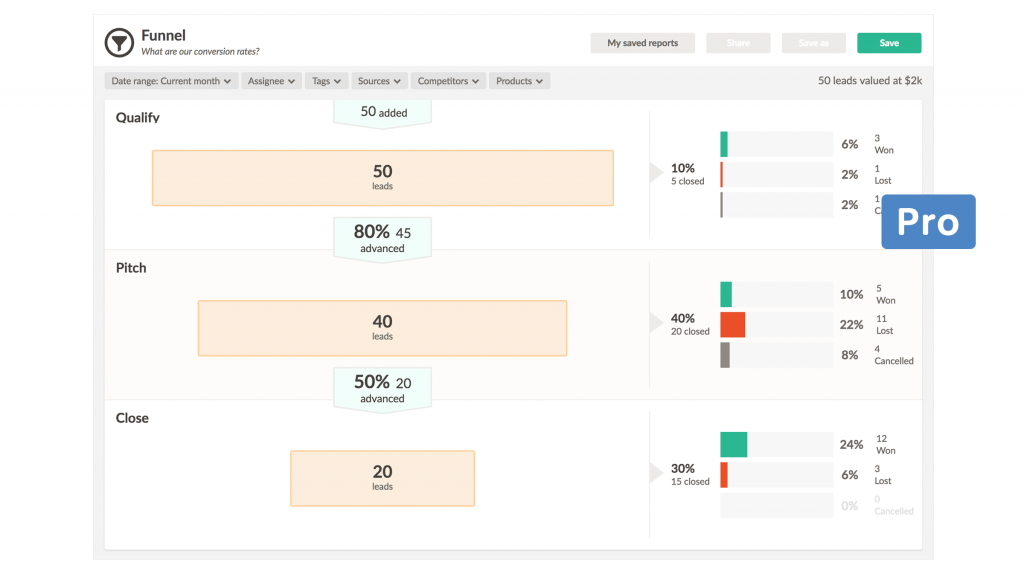
You can define your sales funnel stages in various ways. Often, they line up with the stages of your sales pipeline.
When it comes to leads, prospects, and opportunities, here’s where each type of potential customer exists in the sales funnel:
- Your leads are at the top of the funnel. This is everyone who might reasonably make a purchase.
- Once you qualify a lead, they become a prospect and move to the next stage of the funnel.
- Once a prospect expresses interest in making a purchase, they become a sales opportunity and advance to the next stage.
- The next stage is closing a deal. At this stage, opportunities become customers.
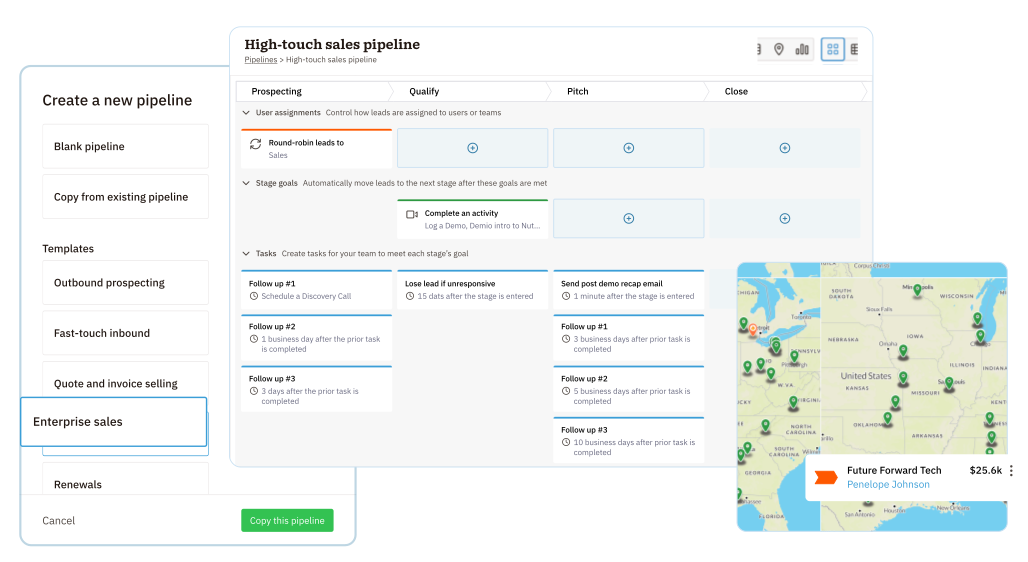
For smaller sales teams without formal pipeline infrastructure, this framework is especially useful. Rather than trying to manage every contact the same way, map your leads, prospects, and opportunities to specific pipeline stages in your CRM. This turns a messy contact list into a clear picture of where your revenue is actually coming from — and where you need to put more work in.
Bloomerang, a nonprofit fundraising platform and Nutshell customer, ran into exactly this challenge. Early on, their pipeline was full — but the volume made it nearly impossible to know which contacts genuinely needed attention. As Jay Love, Bloomerang’s founder and CEO, described it: “A year in, we ended up with more leads than we could follow up on.” Organizing contacts into clear stages is what made the difference between a crowded list and a manageable pipeline.
The benefits of differentiating between leads vs. prospects vs. opportunities
Keeping track of who’s an opportunity, prospect, or lead enables you to focus your efforts on the potential customers who are most likely to convert. This knowledge enables your sales team to use their time, energy, and resources efficiently and close more deals.
Think about what this looks like in practice. A sales rep gets 40 new contacts on Monday morning. Without a clear distinction between leads, prospects, and opportunities, every contact looks roughly equal — which means either everything gets the same shallow attention, or the rep makes judgment calls that aren’t consistent across the team.
With a shared framework, the rep knows immediately: these 12 passed our ICP criteria last week — they’re prospects and need a personal outreach. These three requested a demo — they’re opportunities and need same-day follow-up. The rest are leads who go into a nurture sequence until they’re ready to be qualified.
Speed matters here too. Research tracking more than 15,000 inbound leads found that contacts reached within five minutes of expressing interest were 21 times more likely to qualify than those reached after 30 minutes. A CRM that automatically routes opportunities to the right rep and triggers a follow-up reminder the moment someone fills out a form closes that gap — no manual triage required.
You wouldn’t prepare a two-hour sales presentation for a common lead, would you? You have no idea if this person is a good fit for your company. You’d probably waste a lot of time. If that lead becomes an opportunity, though, you’d absolutely invest the preparation — because now you know the effort is likely to pay off.
Does your sales team have a roadmap for success?
Use our sales process worksheet to standardize your most effective sales efforts and close more deals.
How to move leads through your pipeline
Understanding the definitions is one thing. Actually moving contacts from lead to prospect to opportunity — without losing track of anyone along the way — is where the real work happens. Here’s a practical framework for doing it.
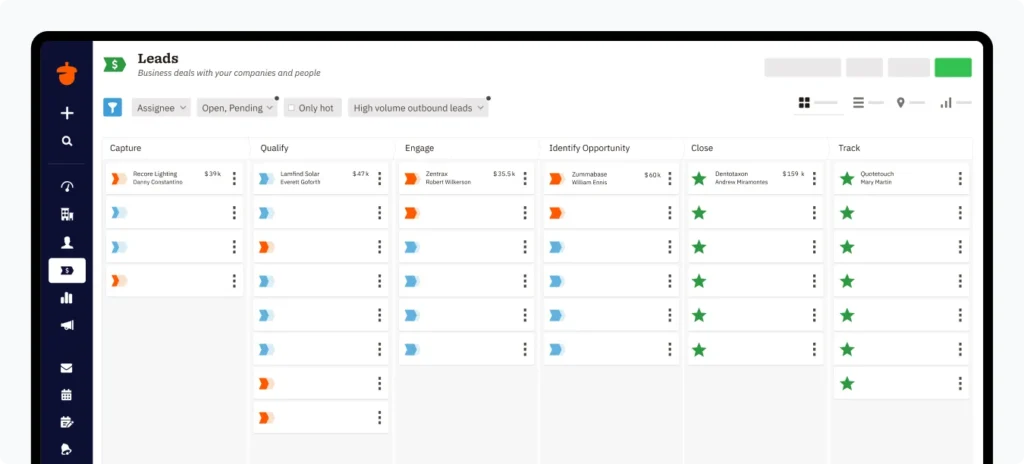
Step 1 — Capture every lead in one place. Whether a contact comes in through a web form, a LinkedIn message, a referral, or a trade show badge scan, they need to land in your CRM immediately. Leads that live in spreadsheets, email threads, or someone’s memory don’t get followed up on consistently.
Step 2 — Qualify leads against your ICP. As soon as a lead enters your pipeline, run them through your qualification criteria. Use BANT or a similar framework to assess fit. If they don’t meet your criteria, don’t discard them — tag them for future nurturing. If they do, upgrade them to prospect status.
Step 3 — Engage prospects with a specific outcome in mind. Prospecting isn’t just about outreach — it’s about gathering the information you need to determine whether this contact is ready to become an opportunity. Ask questions that surface budget, urgency, and buying authority. Listen for the signals that say “I’m ready to move forward.”
Step 4 — Identify the moment a prospect becomes an opportunity. This varies by team, but common signals include a booked demo or discovery call, a request for a proposal or pricing, involvement of additional stakeholders, or a stated purchase timeline within 30 to 90 days. Define this moment clearly so your whole team recognizes it consistently.
Step 5 — Focus your closing efforts on opportunities. Once a contact reaches opportunity status, they get your full attention — tailored proposals, prompt follow-up, and clear next steps after every interaction. Opportunities are rare. Treat them accordingly.
Step 6 — Track everything in your CRM. Every stage transition, every conversation, every follow-up should be logged. This gives you a real-time picture of your pipeline and helps you spot where leads are stalling — whether that’s at the qualification step, the prospect stage, or just before the close.
Put your pipeline to work with Nutshell
Knowing the difference between a lead, a prospect, and an opportunity is the foundation — but the real advantage comes from having a system that makes it easy to act on that knowledge every day.
Nutshell gives your team one place to capture every lead, qualify contacts against your ICP, and track opportunities all the way to close. Automated follow-up sequences mean no one falls through the cracks. Pipeline stage automation keeps every contact moving forward. And built-in reporting shows you exactly where your funnel is losing momentum — so you can fix it before it costs you a deal. If you’re ready to stop managing your pipeline from memory, start a free trial of Nutshell and see how fast it comes together.
Turn website visitors into sales leads
Design and embed simple web forms, track their effectiveness, and quickly reach out to form-fillers, all out of Nutshell.

How to convert prospects to opportunities
It’s great to have prospects. It’s much better to have opportunities. Unlike general leads or prospects, sales qualified leads (SQL) or opportunities have demonstrated both interest and the ability to purchase. These three tips will help you convert more of the prospects in your pipeline to bona fide sales opportunities:
Talk to your prospects
To recap, prospects are leads that match your ideal customer profile. As such, they’re much more likely to become paying customers than the average leads you collect every day.
That’s why we recommend taking time to talk to your prospects and forming a business relationship. Call them on the phone or shoot them an email. Learn about their pain points and daily challenges. Then show them how your company’s products can ease the burdens they’re carrying.
You can’t talk to every lead in your pipeline—and you wouldn’t want to. Your time is too valuable to spend on common leads. But prospects are different. Treat them as such.
Commit to prospect nurturing
Prospect nurturing is similar to lead nurturing, which we outlined above. But instead of developing initial relationships with leads, you develop deeper relationships with prospects.
Again, you can do this with content. Here are the main content types we suggest using to turn prospects into opportunities: webinars and other kinds of virtual events, quizzes and surveys, whitepapers, case studies, video tutorials, data sheets, and email sequences.
The best prospecting content educates prospects on the issues they have, the products and services you sell, and how your products can solve their problems.
Be patient
Most of the prospects in your sales pipeline probably fall into the “not-yet-ready-to-buy” category. That’s okay. You just need to be patient.
If you commit to the nurturing process (see above) and continue to develop relationships with your prospects, many of them will buy from you in the future. Better yet, they’ll remain loyal to you and your company for the long term because you worked so hard to get to know them.
Patience, as they say, is a virtue. Don’t get so caught up in closing deals today that you neglect the deals you’ll close tomorrow, next month, and next year.
Common pitfalls in the lead-to-opportunity process
Your ultimate goal is to convert leads into opportunities with the aim of closing deals. Common pitfalls in the lead-to-opportunity process include neglecting lead scoring, which can result in wasting time and resources on unqualified prospects. Another issue is failing to properly nurture leads, causing them to lose interest or turn to competitors. Additionally, a lack of follow-ups and poor communication can lead to missed opportunities and hinder the progress of potential deals.
Wrapping up
The lead vs. prospect vs. opportunity discussion can lead to a lot of confusion.
Fortunately, you now know the difference between a lead and a prospect or a prospect and an opportunity and why it matters. More importantly, you know how to convert leads into prospects and prospects into opportunities. This will make it much easier for you to close deals at a consistent clip.
Here’s one final piece of advice for you: invest in a piece of software that will help you track leads, prospects, and opportunities so that you always know where they are in your pipeline.
Lead vs. prospect vs. oppportunity FAQs
-
1. What’s the difference between lead and prospect?
A lead is any contact who could realistically buy from your company but hasn’t been vetted yet. A prospect is a lead who has been evaluated against your ideal customer profile and confirmed as a good fit. The key difference is qualification — prospects have cleared the bar, leads haven’t yet. Think of it this way: all prospects start as leads, but most leads never become prospects.
-
2. What are typical conversion rates from lead to opportunity?
A sales opportunity is a prospect who’s actively interested in buying. They’ve moved beyond “I might be a fit” to “I want to learn more” or “I’d like to see a proposal.” Common signals that a prospect has become an opportunity include booking a discovery call, requesting pricing, looping in a decision-maker, or setting a buying timeline. Opportunities represent your highest-probability pipeline and deserve your most focused follow-up.
-
3. What is lead qualification and why does it matter?
Lead qualification is the process of evaluating a lead against your ideal customer profile to determine whether they’re worth pursuing as a prospect. It typically involves assessing budget, decision-making authority, need, and timeline — a framework known as BANT. Qualification matters because it protects your team’s time. Research shows that 67% of lost sales stem from leads that weren’t properly qualified before reaching a closing conversation. The faster your team can sort strong fits from weak ones, the more time they spend on deals that are actually winnable.
-
4. How do MQLs and SQLs fit into this framework?
MQL stands for Marketing Qualified Lead — a contact marketing has flagged as a potential buyer based on engagement signals like content downloads, email opens, or ad clicks. SQL stands for Sales Qualified Lead — a contact that sales has evaluated and confirmed as a genuine fit for outreach. In the lead-prospect-opportunity framework, an MQL is still in lead territory. An SQL is closer to prospect status. The MQL-to-SQL handoff is one of the most important moments in the sales process, and it works best when both teams have agreed in advance on what “qualified” means
-
5. How should I track leads, prospects, and opportunities in a CRM?
The simplest approach is to map each stage to a distinct step in your pipeline. Leads enter at the top — unqualified, just captured. Prospects occupy the middle stages once they’ve been vetted. Opportunities sit at the bottom, actively moving toward a close. In Nutshell, you can build pipeline stages that reflect exactly this journey, automate follow-up reminders, and use the funnel report to see where contacts are stalling. This turns your pipeline from a vague list of contacts into a clear, actionable picture of where your revenue is coming from.
-
6. How quickly should I follow up with a new lead?
As fast as possible — ideally within five minutes of first contact. A study tracking more than 15,000 inbound leads found that contacts reached within five minutes were 21 times more likely to qualify than those reached after 30 minutes. The longer a lead sits without a response, the more their interest fades. If your team can’t realistically hit that window manually, automated lead routing and follow-up sequences in your CRM can close the gap.
-
7. What happens to leads that don’t qualify?
Don’t delete them — nurture them. A lead that doesn’t fit today’s criteria might be a strong prospect in six months if their situation changes. Tag unqualified leads in your CRM with a reason (wrong timing, budget not there yet, not the decision-maker) and add them to a long-term nurture sequence. Check back in quarterly. Some of your best future customers are sitting in your “not yet” pile right now.
See Nutshell in action!
Try Nutshell free for 14 days or let us show you around before you dive in.
 BACK TO TOP
 Written by
Kevin Randolph Partnerships and Outreach SpecialistEdited by
Will Gordon Sr. Director of MarketingReviewed by
Andy Fowler Co-FounderReady to try
Nutshell for Free?Thank you! Your submission has been received!Oops! Something went wrong while submitting the form.




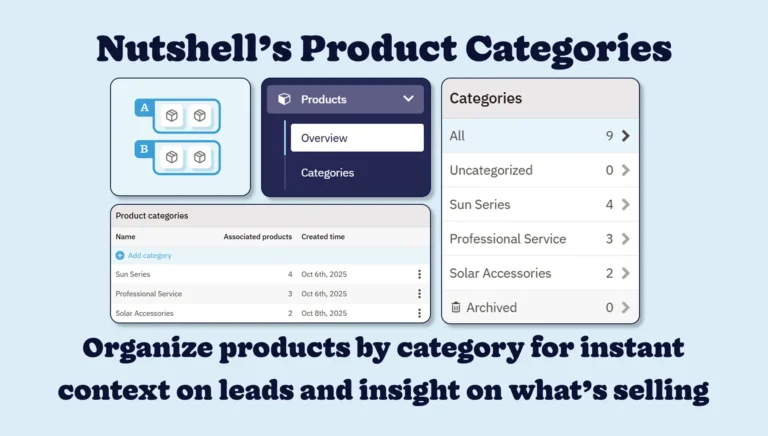
Organize, Analyze, and Sell Faster With Product Categories in Nutshell
Published on: October 9, 2025
Highly Effective Strategies for Elevating Sales Team Performance
Published on: November 10, 2022Establishing a System for CRM Data Entry and Management
Published on: April 11, 2023Introducing Nutshell Forms Spam Prevention
Published on: April 22, 2024Join 30,000+ other sales and marketing professionals. Subscribe to our Sell to Win newsletter!